
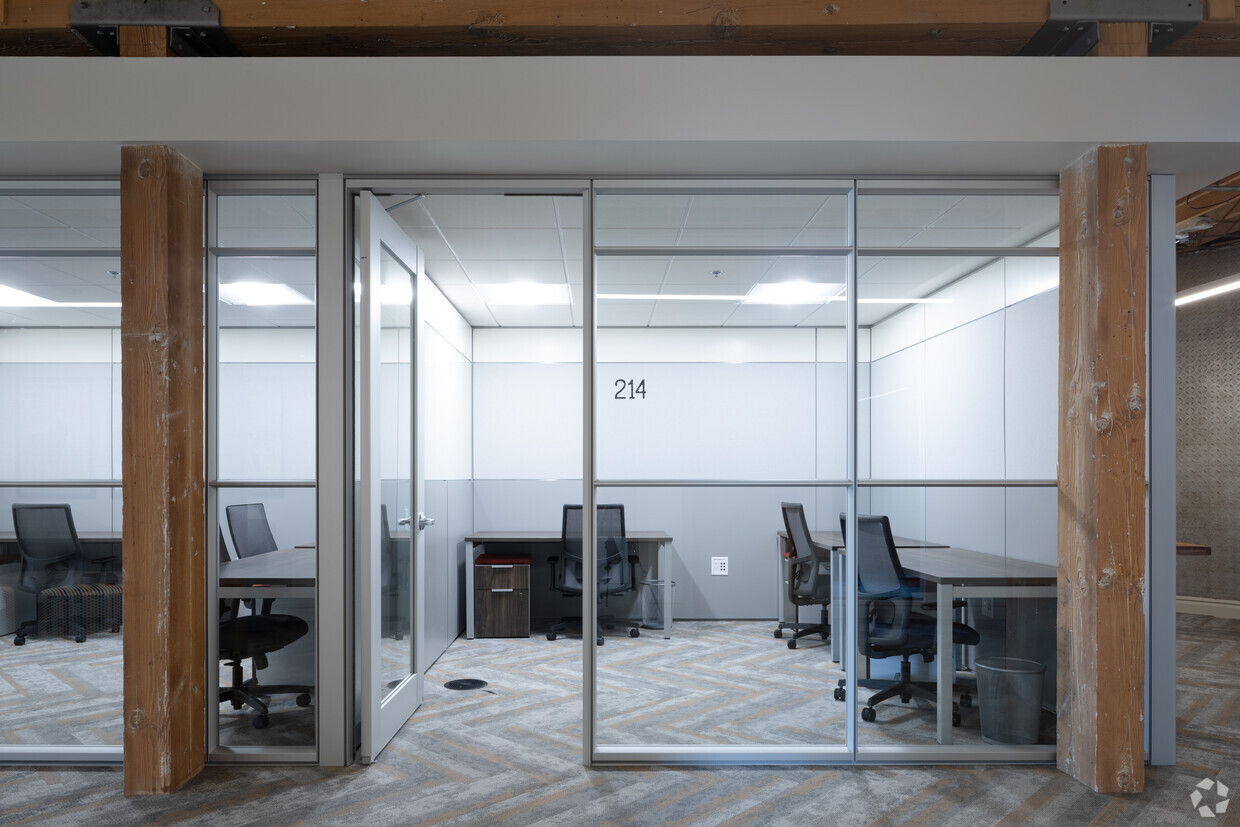
Choosing office space in Denver usually comes down to two paths: a private office inside a professionally managed, flexible building, or a traditional commercial lease signed directly with a landlord. Both give your business a dedicated, lockable workspace, but they differ sharply in cost structure, lease length, setup time, and how much control a company has over its environment.
The right choice depends on team size, how predictable your space needs are, and how much flexibility your business needs as it grows. This guide compares both options across cost, commitment, amenities, privacy, and branding, so you can weigh which one actually fits your company.
What Is Private Office Space?
A private office is not the same thing as a seat at a shared coworking desk. It’s an enclosed, lockable workspace occupied by one person or one team, typically inside a larger, professionally managed building.
The tenant gets full privacy behind their own door while still drawing on shared infrastructure the building provides:
- Reception and common areas
- Meeting rooms
- Kitchens
- Restrooms
- Internet
- Printing
- Lounge space
- General building services
In short: a private office is a locked room a company controls, sitting inside a building whose shared amenities the company doesn’t have to build or manage itself.
Who Typically Uses Private Office Space?
Private offices tend to attract real, established businesses as much as solo workers, including:
- Startups and small businesses
- Consultants, attorneys, accountants, and financial professionals
- Sales teams and project teams
- Remote employees who need a dedicated place to work
- Companies opening a satellite office or entering the Denver market for the first time
- Entrepreneurs who need a professional address without the overhead of a full lease
What Is a Traditional Office Lease?
A traditional office lease is a longer-term agreement where a business leases a defined commercial suite directly from a landlord.
The tenant usually takes on more of the responsibility for turning that raw or existing space into a working office, which can mean arranging and paying for:
- Furniture
- Internet
- Utilities
- Insurance
- Cleaning
- IT
- Repairs and maintenance
- Buildout
- Security or access systems
- Conference rooms
- Kitchen equipment
- Signage
- Moving and deposits
Not every traditional lease is structured the same way. Costs can shift significantly depending on whether the agreement is full-service, modified gross, triple net, or some other negotiated structure.
Cost: Private Office Space vs. Traditional Office Lease
Comparing these two options on monthly rent alone misses the point. The real comparison is total occupancy cost, meaning everything your business has to pay to actually operate in the space.
Upfront Costs
| Private Office | Traditional Lease | |
| Furniture | Often already included | Usually purchased separately |
| Internet & infrastructure | Often already in place | Usually installed separately |
| Meeting/common areas | Often included | May need to be built out |
| Typical added costs | Minimal | Security deposit, IT setup, moving, buildout, signage, equipment, design, conference-room setup |
A furnished, internet-ready private office can reduce how much capital your business needs before it ever moves in. A traditional lease more often asks the tenant to fund the buildout themselves, so the monthly rent figure is only one part of the real cost of a traditional office.
Monthly Costs
| Private Office | Traditional Office |
| Often one combined fee covering some mix of office, furniture, internet, utilities, common areas, amenities, cleaning and maintenance | Separate line items can include base rent, operating expenses, utilities, internet, cleaning, maintenance, parking, insurance, IT, and equipment |
Actual lease terms vary by property and by landlord.
Cost Per Employee vs. Cost Per Square Foot
Traditional commercial leases are usually priced and discussed in dollars per square foot per year. That’s a useful number for comparing buildings, but it doesn’t tell you whether your business is spending efficiently.
What matters more is the total workspace cost per employee. A small team doesn’t necessarily need, or efficiently use, an entire traditional suite sized for a much larger headcount. A private office can let a business pay for the capacity it needs right now, instead of carrying space it isn’t using.
Don’t Forget the Cost of Unused Space
Here’s a scenario worth sitting with: a traditional office built out for 15 people, occupied by a team of 6. That company is effectively paying for empty offices, empty desks, unused conference rooms, and excess common area, whether anyone sits in them or not.
A private office arrangement makes it easier to size a workspace to current headcount rather than to a lease signed years earlier. That doesn’t mean a private office will always come out cheaper overall, but it removes one of the more common ways traditional tenants overpay.
Lease Length & Flexibility
Flexibility has become a bigger factor in how companies choose office space. CBRE’s 2026 occupier research frames flexible space as a mainstream part of how businesses manage uncertain demand, enter new markets, and preserve capital, rather than a niche option.
Private Office Agreements
Depending on the property, private office agreements can offer shorter commitments, easier expansion or downsizing, less exposure if headcount changes, and a lower-risk way to open a new Denver location. Exact terms vary by building, so it’s worth confirming what a specific property actually offers.
Traditional Office Leases
Traditional leases can offer long-term control, more predictability, and the ability to fully customize a space, which can produce better economics for larger or more stable tenants. The tradeoff is a longer commitment, less ability to change footprint quickly, and, for a business that outgrows or stops needing the space, a possible obligation to sublease it.
Move-In Time & Office Setup
How do move-in time and setup vary between private and traditional offices? Let’s take a look.
Moving Into a Private Office
If a space is furnished and internet-ready, moving in can be fairly simple: pick an available office, sign the agreement, bring in laptops and personal items, and start working.
Moving Into a Traditional Office
A traditional office often involves more steps:
- Lease negotiation
- Space planning
- Buildout
- Furniture procurement
- Internet installation
- IT setup
- Signage
- Insurance
- Moving logistics
- Coordinating multiple vendors
That doesn’t mean every traditional lease takes months to open, but setup is typically more involved; how involved depends heavily on the condition of the space being leased.
Furniture, Internet, and Office Amenities
A private office may come with access to:
- A furnished workspace
- High-speed internet
- Conference rooms
- A kitchen or break area
- Reception and common spaces
- Printing
- Mail service
- Phone booths
- Parking
- Building access
However, what’s included depends on the specific property. It’s worth confirming which of these are actually part of a given listing rather than assuming they all come standard.
A traditional lease generally gives a company more control over exactly what it sets up, but that control comes with the responsibility of sourcing most of these services independently rather than having them bundled in.
Privacy & Professionalism
It’s a fair assumption to worry that flexible office space means an open, noisy coworking floor. But a genuine private office isn’t that.
Private Office
A true private office is an enclosed, dedicated space, separated from any open coworking areas, built for focused work and, where meeting rooms are available, professional client meetings. That makes it a reasonable fit for client calls, sensitive conversations, deep work, and small-team collaboration.
Traditional Office
A traditional office typically offers more control over the details: the floor plan, who has access, reception, conference rooms, acoustic treatment, branding, and employee-only areas. This is one area where a traditional lease can clearly be the better option for some companies, particularly those that need a highly specific layout or access setup.
Branding & Customization
This is an area where a traditional lease has a real edge.
In a private office, customization is usually limited to layout, furniture arrangement, décor, and signage where the building permits it.
A traditional office generally allows more freedom around company branding, interior design, layout, reception, signage, conference rooms, and dedicated amenities built specifically around the business.
Key question: Is your office primarily a place to work, or is it also an important extension of your brand? That distinction is often the deciding factor between the two options.
Which Option Is Better for a Growing Business?
A private office can work well when:
- Headcount is uncertain
- The team is actively growing
- The company doesn’t yet know its 2–5 year space needs
- The business is testing the Denver market
- Hybrid work makes in-office attendance unpredictable
A traditional lease may work better when:
- Headcount is stable
- Space needs are predictable
- The company expects to stay long-term
- A custom buildout matters
- The business needs a large, contiguous space
Which Option Works Better for Hybrid Teams?
Hybrid companies often don’t need a permanent desk for every employee on payroll. What they need instead is rotating attendance space, meeting rooms, private team rooms for occasional collaboration, and a base for remote employees or satellite teams visiting Denver.
Because a private office can flex with fluctuating utilization, it tends to fit hybrid work patterns more naturally than a fixed traditional suite sized for full-time, everyone-in-the-office attendance.
What About Parking and Location in Denver?
Location and parking can affect the real, all-in cost and convenience of an office as much as the lease terms do. Before choosing either option, it’s worth comparing:
- Employee commute times
- Highway access
- Public transit options
- Parking availability
- Client accessibility
- Nearby restaurants and services
- The surrounding neighborhood
- Building access
- Proximity to the airport (if relevant)
Parking in particular can materially change the true monthly cost of a space, so it’s worth asking directly: Is parking included, discounted, leased separately, or unavailable?
Denver’s Office Market: Why Businesses Have More Choices
As of Q2 2026, CBRE reported Denver’s overall office vacancy at 28.7%, alongside the strongest quarterly leasing activity the market has seen since Q1 2022.
Downtown vacancy remained considerably higher, at 38.6%, even as conditions improved. The important takeaway is that businesses currently have meaningful choice across Denver office space, and demand, particularly for higher-quality buildings, is starting to pick back up.
CBRE also expects the gap between prime, Class A space and lower-quality space to keep widening as tenants increasingly prioritize better buildings and amenities.
Private Office vs. Traditional Lease: Which Is Better for Different Businesses?
Solo Professionals
A private office tends to be the stronger fit here: it provides a professional address and work environment, real privacy, and none of the overhead of leasing more space than one person needs, with a much lower setup burden than a traditional lease.
Small Teams
Private offices often work particularly well for small teams, since flexible buildings typically offer a range of sizes, from two-person offices up to five or more seats, depending on availability. If a growing team fits this description, it’s worth checking current listings to see what sizes are open right now.
Startups
For startups, the priority is usually flexibility, preserving capital, adapting to changing headcount, and moving in fast, all of which point toward a private office over a longer commercial commitment.
Satellite Offices
This is one of the strongest use cases for a private office. A company headquartered elsewhere that needs a Denver presence can get one without building out a full second office from scratch.
Established Larger Companies
A traditional lease tends to make more sense once headcount is predictable, the company needs a larger dedicated space, branding matters, a custom buildout is worth the investment, and the business has an established, long-term presence in Denver.
When Does a Private Office Make More Sense?
A private office may be the better fit if:
- You need space quickly
- Your team is relatively small
- Headcount may change in the near term
- You don’t want to furnish an office yourself
- You want more predictable monthly costs
- You don’t want to manage office infrastructure
- You need occasional meeting rooms but not a dedicated conference suite
- You’re opening a Denver satellite office
- You don’t want a long commercial lease
- Your company runs a hybrid model
When Does a Traditional Office Lease Make More Sense?
Traditional leasing may be the better choice if:
- You have a larger team
- Your space requirement is stable
- You expect to stay for several years
- Custom branding is important to your business
- You need a specialized layout
- You require complete control over access
- You need dedicated conference rooms, reception, and amenities
- You can justify the setup and buildout costs
Questions to Ask Before Choosing Office Space in Denver
What’s actually included in the monthly price?
Ask specifically about utilities, internet, furniture, cleaning, meeting rooms, parking, mail, printing, and building access, since these details vary widely between properties.
What is the minimum commitment?
Minimum terms vary by property, from month-to-month agreements to fixed multi-month or multi-year commitments. Confirm this upfront, since it directly affects how much flexibility you actually have.
Can I expand or downsize?
Ask whether the property allows moving into a larger or smaller office as headcount changes, and how much advance notice that requires.
Is the office furnished?
Furnishing varies by listing, so confirm whether desks, chairs, and other basics are included or whether you’ll need to bring or buy your own.
How many people comfortably fit?
Get a clear headcount recommendation for the specific office rather than relying on square footage alone, so you’re not cramped or paying for space you don’t use.
Are meeting rooms included?
Ask whether meeting room access is bundled into the rate, available by the hour, or not included at all.
What parking is available?
Confirm whether parking is included, offered at an extra cost, or handled separately from the building, since this can meaningfully change your real monthly cost.
Is internet included?
Check whether internet is part of the base price or billed separately, and ask about connection speed if your team relies on video calls or large file transfers.
Can clients visit the office?
Ask whether the property allows outside visitors and what that experience is like, especially if client meetings are a regular part of your business.
What happens if my team grows?
Find out whether you can add seats, move to a larger office, or take on an additional office in the same building as your team expands.
Explore Private Office Spaces Available in Denver
If a private office sounds like the better fit based on what’s covered above, the next step is to look at what’s actually available. Explore our Denver offices to compare locations, office sizes, amenities, and current availability.
View Available Private Offices in Denver
Private Office Space vs. Traditional Lease: FAQs
What is the difference between private office space and coworking?
Coworking usually refers to shared, open workspace where different people or companies work in the same area. A private office is an enclosed, dedicated room or suite that one team occupies exclusively, even within a shared building.
Is a private office cheaper than a traditional office lease in Denver?
It depends. The honest comparison is total occupancy cost, and that depends on factors like size, lease term, furniture, utilities, internet, amenities, buildout, parking, and staffing or services included.
What is included with private office space?
This varies by property. Always check the specific listing to confirm exactly what’s included before assuming a feature is standard.
How long do traditional Denver office leases last?
There’s no single standard length. Lease terms are negotiated and vary by landlord, building, size, and tenant.
Can I rent a private office for a small team?
Yes, depending on current availability. View available offices to see current sizes and pricing.
Can I upgrade to a larger office as my company grows?
This depends on what’s available at the time and the specific property’s policies. It isn’t guaranteed across every building, so it’s worth asking directly.
Are private offices furnished?
Some are, some aren’t. Check current listings to confirm furnishing status for a specific office.
Can I meet clients in a private office?
Generally yes, where the property allows visitors, though meeting-room availability depends on the specific facility.
Is parking included with private office space in Denver?
It depends on the property. Compare individual listings to see how each one handles parking.
Is a private office good for a hybrid team?
Often, yes. It offers a lower fixed footprint, a collaboration point, a meeting location, and capacity that can flex with attendance.
Is private office space good for a Denver satellite office?
Yes, this is one of the strongest use cases, since it reduces setup complexity and long-term commitment for a company without an existing Denver presence.
Where can I see available private offices in Denver?
View available Denver office spaces for current listings.
Find the Right Office Space in Denver
A private office can make sense when flexibility, fast setup, and lower operational complexity matter most. A traditional lease can be the better call when your company needs more control, customization, and dedicated long-term space.
The right answer comes down to your team’s size, how predictable your space needs are, and how much you value speed and flexibility versus control and branding.
