Your startup doesn’t need a giant office. It needs a place where your team can actually work, meet clients, take calls, and grow without taking on more overhead than necessary.
If you’re looking for office space for a startup in Denver, don’t ask: How much office space can we afford? Ask: What do we actually need right now?
This guide breaks down the options, costs, locations, and practical considerations so you can make that decision without spending days touring offices that aren’t a good fit.
In a hurry? Here’s the short version:
| If your startup is… | Consider…. |
|---|---|
| Just you | Hot desk or dedicated desk |
| 2-3 People | Small private office |
| 3-5 People | Private startup office |
| 5-10 People | Larger private office/team suite |
| Mostly remote | Flexible coworking + meeting rooms |
| Growing quickly | Flexible office you can scale |
Ready to learn more? Let’s get into the details.
What Kind of Office Does a Startup Actually Need?
The right answer depends less on your industry and more on your stage. Here’s how it breaks down.
You’re a solo founder
You probably don’t need a traditional office. A hot desk or dedicated desk may give you everything you need without paying for unused square footage.
You’re a 2–3 person startup
This is where a private office starts making sense. You get:
- Privacy
- A consistent place for your team
- Space for calls
- A professional environment to meet with clients
- Your own desks and storage
You’re building a 4–8 person team
Now think about the team dynamic.
You need enough room for everyone to work comfortably, but also access to meeting rooms and shared space. This is where flexible private offices inside a coworking space can be much more practical than signing a traditional commercial lease.
You’re hiring quickly
Don’t choose an office based solely on today’s headcount. Ask: “What happens if we hire three more people in six months?” That’s a much more useful question than “What do we need right now?”
Startup Office Space vs. Working From Home
Coworking can have lots of benefits compared to working from home, but it isn’t automatically better.
Working from home makes sense when:
- You’re solo
- Most of your work is independent
- You rarely meet clients
- You don’t need a dedicated team environment
An office starts making sense when:
- Your team is growing
- Home is becoming distracting
- You need frequent meetings
- You need somewhere professional to meet clients
- Your team needs separation between work and home
- You’re hiring people who need a consistent workspace
You don’t need an office because you’re a “real” company. You need one when an office solves a real problem for your business.
How Much Does Startup Office Space Cost in Denver?
Startup office space doesn’t have a single, average price. Costs vary significantly based on location, size, amenities, and lease structure. So it’s more helpful to understand the different pricing models.
Coworking membership
At the low end of the price scale, we have coworking memberships.
For a small monthly fee, you get access to shared desks, phone booths, lounge spaces, and whatever amenities the coworking space offers.
A coworking membership is best for founders who don’t need a private office every day.
Dedicated Desk
Dedicated desks cost more than coworking memberships but are still quite affordable compared to renting a private office.
In addition to the coworking space’s amenities, you get a desk reserved just for you. Sometimes, this will also include lockable storage so you don’t have to bring all your equipment back and forth every day.
A dedicated desk is best for a founder (or employee) who wants a permanent workstation without leasing an entire office.
Private office
Private offices in a coworking space cost more than dedicated desks, but they’re usually more affordable than a traditional commercial office lease.
At minimum, you’ll get your own office space with a door that closes and locks. Depending on the coworking space, your office may also include furniture (though sometimes this costs extra).
Private offices are best for small teams that need privacy and their own workspace.
Traditional commercial lease
Traditional commercial leases need little explanation; they’re the type of setup you’re probably picturing when you think of “renting an office.”
They range in size from a couple of rooms to an entire floor of a building (or even an entire building). How much space you get depends on what you’re willing to spend.
Traditional commercial leases are best suited to companies that have enough headcount and financial predictability to justify taking on a larger, longer-term commitment.
Real example pricing from Candy Factory Coworking
For a concrete example of what startup office space costs in Denver, here are the current rates for Candy Factory Coworking:
- Hot desk: $200/month
- Dedicated desk: $500+/month
- 3-person private office: $807+/month
- 5-person private office: $1,200+/month
- 7-person private office: $1,325+/month
We hope this gives you a better idea of what to expect.
What Should Be Included in a Startup Office?
Here’s what to actually look for, practically speaking.
Fast, reliable internet
This should be a given these days. It’s especially important for software, SaaS, agencies, consultants, and remote teams.
Meeting rooms
A four-person startup doesn’t necessarily need a four-person office plus a private conference room inside it.
Shared meeting rooms can be much more efficient, and they give you the flexibility to choose different meeting room sizes depending on your needs.
Private areas for calls
For some parts of your business, privacy is essential. Private areas for calls are particularly important for founders doing sales calls, investor conversations, and client meetings.
24/7 access
This feature is useful if your team doesn’t work traditional 9–5 hours (or you often find yourself staying late at the office).
Furniture
A furnished office means you aren’t spending another several thousand dollars getting desks, chairs, and storage into the space.
Printing, mail, and basic office services
These seem like small things, but they remove a surprising amount of operational hassle.
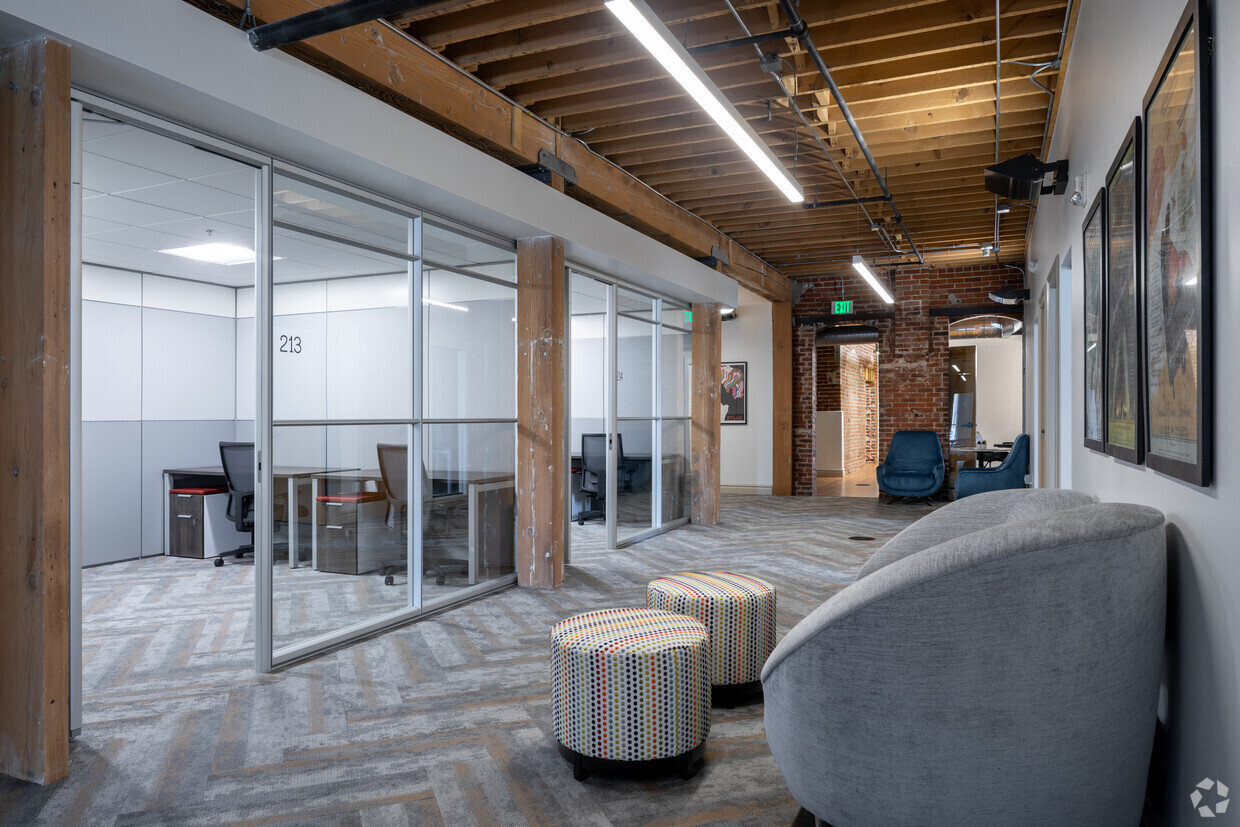
At Candy Factory, our offices come with:
- Fiber-optic internet
- Conference facilities
- Mail service
- Controlled access
- Kitchen facilities
- Secure storage
- 24-hour access
Where Should a Startup Rent Office Space in Denver?
Rather than a list of every Denver neighborhood, here’s what type of location actually makes sense for different founders.
Downtown Denver
Best if:
- You meet clients regularly
- Your team values walkability
- You want access to restaurants and entertainment
- Employees use public transportation
- You want a central business address
Candy Factory is located in the Denver Theatre District at 1512 Curtis Street, close to 16th Street Mall, the Denver Performing Arts Complex, and the Colorado Convention Center, with several nearby RTD stations within walking distance.
Denver Tech Center (DTC)
Best if:
- Your team or clients are based in the southeast metro area
- You want easier access to I-25 and free or cheaper parking
- You’re serving corporate clients rather than a downtown crowd
- Your team commutes by car rather than transit
The DTC tends to appeal to more established or client-facing startups that need proximity to bigger corporate tenants, rather than the walkable, street-level energy of downtown.
RiNo (River North Art District)
Best if:
- Your team wants a creative, less corporate atmosphere
- You value being near breweries, restaurants, and galleries for informal meetings or team culture
- You’re a design, creative, or early-stage tech startup
- You don’t need a traditional “downtown business” address
RiNo has become a popular option for younger companies that want character and flexibility over a formal corporate setting, though it can mean a longer commute for team members coming from other parts of the metro.
Do Startups Need a Private Office?
A private office makes sense when:
- You have 2+ people
- You take confidential calls
- Your team collaborates frequently
- You meet clients
- You want a consistent company workspace
- You need somewhere to leave equipment and documents
Coworking makes more sense when:
- You’re mostly solo
- Your schedule changes
- You’re testing whether you even need an office
- Your team is remote
- You don’t need privacy every day
If you’re somewhere in the middle, don’t force yourself into one model. A flexible workspace can give you a private office while still letting you use shared amenities and meeting spaces when you need them.
What Should Founders Look for When Touring an Office?
Ask these questions before you sign anything:
- What’s actually included in the monthly price? Don’t compare rent against rent; compare the total monthly cost.
- Is the internet included?
- How much does meeting room access cost?
- Can I access the office outside normal business hours?
- Can I add another desk or office if we hire?
- What happens if we need less space?
- Is the office furnished?
- Where will clients park or arrive?
- Can I take private calls?
- What’s the actual noise level?
That last one matters more than people expect. People care about the actual day-to-day working environment, which is something you can’t learn about from marketing photos or promo videos.
Our advice: Don’t just tour the office. Work there for an hour (or even a full day) if you can.
Is Coworking Actually Useful for Startup Networking?
Coworking won’t magically grow your startup. But working around other founders, freelancers, and small businesses can create opportunities you wouldn’t get sitting alone at home.
Denver has an established startup community outside coworking spaces too, including recurring founder events and communities.
That’s why at Candy Factory, we aim to create a community of entrepreneurs and professionals, and our space includes shared areas and community programming.
Why Some Startups Choose Downtown Denver
For many startups, the appeal comes down to business practicality. Downtown Denver gets you:
- Central location
- Client meetings
- Restaurants
- Hotels
- Entertainment
- Public transit
- Walkability
- Professional address
Take Candy Factory, for example. Our address is near the Denver Theatre District, a block off 16th Street Mall. Restaurants, cultural venues, and transit connections are all within an easy walk.
Startup Office Space at Candy Factory Coworking
If you’re a Denver startup with a small team, you probably don’t need 5,000 square feet and a five-year lease.
Instead, you need a professional place for your team to work, enough privacy to have real conversations, reliable internet, meeting space when you need it, and the flexibility to change as the company changes.
That’s what Candy Factory is built around:
- Downtown Denver / Denver Theatre District
- Historic Baur’s Building
- Private offices
- Options for small teams
- Furnished offices
- Fiber internet
- Meeting rooms
- Shared workspace
- 24/7 access on applicable memberships
- On-site management
- Mail service
- Kitchen/common areas
Explore available office space in Denver
Frequently Asked Questions About Coworking in Denver
What is the best office space for a small startup in Denver?
It depends on your team size and working style. A solo founder may only need a hot desk, while a 3–5 person team will usually get more value from a private office with room to grow..
How much does a startup office cost in Denver?
It depends on the business model. Private offices, coworking memberships, and traditional leases have very different pricing structures, so it’s worth comparing total monthly cost rather than just headline rent.
Is coworking cheaper than renting a traditional office?
Sometimes. It can reduce setup and operating overhead since furniture, internet, and utilities are typically included, but it isn’t automatically cheaper on a per-square-foot basis.
How much office space does a startup need?
Rather than an arbitrary square-foot number, size your space around your team today plus realistic near-term hiring expectations.
Should a startup rent a private office or use coworking?
If you need privacy, take confidential calls, or meet clients regularly, a private office usually makes more sense. If your team is mostly remote or your schedule changes often, coworking offers more flexibility.
Can a startup get a short-term office in Denver?
Yes. Many providers offer flexible, month-to-month memberships. Check the agreement for notice periods, what happens if you need to scale up or down, and whether pricing is locked in.
Is downtown Denver a good location for a startup office?
For many teams, yes. Downtown offers walkability, access to clients, public transit, and a recognizable address. Whether it’s right for you depends on where your team and clients are actually located.
Find an Office That Fits Your Startup
You don’t need to guess how much space your team needs from a floor plan. Take a look at our current private offices, compare sizes and pricing, and find a workspace that fits where your company is today.
